
Information Centre
Practitioner briefings for Australian employers.
Practical guidance on workplace advisory, investigations, psychosocial safety, mediation, training and governance, risk and compliance. Written by the AWS Editorial Team for HR, safety, legal and executive readers.
Workplace Advisory & Compliance
27 articles

Workplace Advisory & Compliance
AI in Fair Work disputes: lessons for employers from recent decisions
Four recent Commission matters show why employers should separate substance from volume, verify every filing and keep human judgment in control when AI enters a workplace dispute.
Read briefing →
Workplace Advisory & Compliance
Employee underpayment confirmed: remediation, regulator engagement and enforceable undertakings
What employers should do after an underpayment is confirmed: contain the error, validate and pay the remediation, manage tax and super separately, decide regulator engagement and build evidence that the problem will not recur.
Read briefing →
Workplace Advisory & Compliance
When workplace standardisation becomes disability discrimination: lessons from the million-dollar Boroondara decision
A case-led briefing on separating the genuine requirements of a job from the employer's preferred method of performing it, and on the consultation that reasonable adjustment requires.
Read briefing →
Workplace Advisory & Compliance
Dismissing an employee for medical incapacity: an employer's guide
More than three months' absence does not create a right to dismiss. A defensible medical-capacity decision needs current functional evidence, an accurate statement of what the position actually requires, genuine consideration of adjustments, a fair process and contemporaneous proof of the decision-maker's reasons.
Read briefing →
Workplace Advisory & Compliance
Responding to an unfair dismissal application: an employer's first steps
What an employer should do in the days after a Fair Work Commission unfair dismissal application arrives: confirm the deadline, preserve the record, assess objections and merits separately, lodge a considered Form F3 response and prepare for conciliation.
Read briefing →
Workplace Advisory & Compliance
Employment contracts: practical review points for Australian employers
A structured review approach for Australian employment contracts — testing the document against the real role, the applicable instruments and the National Employment Standards, and governing templates, variations and records over time.
Read briefing →
Workplace Advisory & Compliance
Responding to a general protections dismissal application: an employer’s first steps
A calm first-response framework for employers served with a general protections dismissal application — triage and preservation, identifying the alleged adverse action and reason, the statutory presumptions, objections, Form F8A and the Commission conference.
Read briefing →
Workplace Advisory & Compliance
Retained or project-based workplace advisory: choosing the right support model
A decision guide for boards, executives and people-and-culture leaders weighing a retained advisory arrangement, a defined project engagement or a deliberately designed hybrid — with a decision framework, governance provisions and a pre-engagement checklist.
Read briefing →
Workplace Advisory & Compliance
Fixed-term contracts: rules, exceptions and employer controls
A practical guide to assessing, approving, documenting and monitoring fixed-term contracts under the Fair Work Act.
Read briefing →
Workplace Advisory & Compliance
Right to disconnect: managing after-hours contact in practice
How Australian employers set role-by-role contact rules, fund genuine after-hours coverage and assess whether a refusal to respond outside working hours is reasonable.
Read briefing →
Workplace Advisory & Compliance
Workplace delegates' rights: employer obligations and practical controls
How employers identify workplace delegates, read the applicable delegates' rights term, and administer communication, facilities and paid training requests consistently.
Read briefing →
Workplace Advisory & Compliance
Flexible work requests: assessing and responding lawfully
An operational guide to handling statutory flexible work requests: intake and triage, genuine discussion, particularised business grounds, the 21-day written response and the Commission pathway.
Read briefing →
Workplace Advisory & Compliance
Casual employment: assessing status and responding to employee-choice notices
An operational guide to casual employment for employers: the current definition, reviewing engagements against practical reality, and running the employee-choice notice process from intake to implementation.
Read briefing →
Workplace Advisory & Compliance
Employee or independent contractor? Applying the whole-of-relationship test
A practical employer guide to employee-or-contractor classification: selecting the applicable Fair Work Act test, assessing the contract together with how the work is actually performed, and recording a defensible conclusion.
Read briefing →
Workplace Advisory & Compliance
Managing termination risk through fair and documented processes
Contested dismissals are usually lost before the final meeting. This guide sets out the decision system behind a defensible termination — classification, claim screening, evidence, procedural fairness, proportionality, mechanics and records.
Read briefing →
Workplace Advisory & Compliance
Employee communication during restructures and workplace change
Communication is a control, not a substitute for lawful process. This briefing sets out how employers map consultation obligations, fix decision status, sequence messages and record feedback through restructures and other significant workplace change.
Read briefing →
Workplace Advisory & Compliance
Personal leave disputes: notice, evidence and practical employer responses
Personal leave disputes often escalate when notice or evidence is unclear. This briefing outlines a measured, employer-facing approach.
Read briefing →
Workplace Advisory & Compliance
Accessorial liability for underpayments: who else can be personally liable
An underpayment starts with the employer, but section 550 of the Fair Work Act asks a second question: was anyone else knowingly involved? This guide explains the test, the evidence courts look for, how section 557A, section 558B and the criminal offence differ, and what to do on finding a suspected underpayment.
Read briefing →
Workplace Advisory & Compliance
Updating workplace policies: notice, consultation and documented consent
A practical Australian employer guide to changing policies, rules, directions and contract terms — what consultation is actually required, how to set notice and effective dates, and why acknowledgement is not consent.
Read briefing →
Workplace Advisory & Compliance
Employee social media conduct: when should employers respond?
Personal social media use is not automatically a workplace matter. This guide sets out how Australian employers assess employment nexus, screen protections, preserve evidence lawfully and respond proportionately.
Read briefing →
Workplace Advisory & Compliance
Performance management and procedural fairness in workplace processes
Performance management decisions are routinely challenged. A structured, well-documented process protects both employees and employers.
Read briefing →
Workplace Advisory & Compliance
Redundancy, restructure and job redesign: documentation and consultation
Restructure processes are an area of repeated regulator and tribunal scrutiny. We outline the consultation steps and documentation employers should prepare.
Read briefing →
Workplace Advisory & Compliance
Genuine redundancy: consultation, redeployment and documentation risks
Redundancy, genuine redundancy and redundancy pay answer different questions. This guide sets out the decision and evidence system behind a proposed redundancy — operational analysis, instrument mapping, consultation, redeployment, lawful selection, entitlements and record integrity.
Read briefing →
Workplace Advisory & Compliance
Preparing for enterprise bargaining: an employer's roadmap
Making a single-enterprise agreement is a statutory process with fixed steps and deadlines. This roadmap follows the pathway from scoping and notification time through to approval and payroll implementation.
Read briefing →
Workplace Advisory & Compliance
How to determine award coverage and classification
Coverage, application and classification are three separate questions, and job titles, salaries and payroll codes answer none of them. A step-by-step method for reaching a position you can stand behind.
Read briefing →
Workplace Advisory & Compliance
How to conduct a wage compliance review
An end-to-end guide for employers on governing, scoping, calculating, verifying and acting on a wage compliance review.
Read briefing →
Workplace Advisory & Compliance
Responding to compliance notices: practical steps for employers
A document called a notice is an instrument with its own enabling law, deadlines and review route. This briefing sets out the response operating system: classify the instrument, protect immediate safety and pay, preserve evidence, coordinate accurate regulator engagement, verify corrective action and close out on evidence.
Read briefing →Workplace Investigations
7 articles

Workplace Investigations
How to review a workplace investigation before relying on its findings
A practical guide to testing whether a completed or partly completed workplace investigation is sufficiently fair, complete and reasoned to support an employer decision.
Read briefing →
Workplace Investigations
How Long Should a Workplace Investigation Take?
An employer guide to planning, monitoring and defending the duration of a workplace investigation once fact-finding has been chosen as the pathway.
Read briefing →
Workplace Investigations
Early triage of workplace complaints: the first 24–72 hours
Before allegations are framed or a process begins, someone has to decide who owns the matter, what needs preserving and which pathway fits. This guide sets out that early assessment.
Read briefing →
Workplace Investigations
Managing discrimination and harassment complaints: an employer guide
Discrimination and harassment complaints turn on characterisation, risk control and fair process. This guide sets out how Australian employers map the issues, choose a pathway, make defensible findings and meet the positive duty.
Read briefing →
Workplace Investigations
When should an employer appoint an external workplace investigator?
A decision guide for choosing between an internal investigator, an external appointment or a hybrid model — external is not automatically the safer choice.
Read briefing →
Workplace Investigations
Managing a workplace complaint: the employer's guide after triage
What employers should do once a complaint has been received and triaged: confirming the pathway, interim measures, scope, procedural fairness, findings, communication and follow-through.
Read briefing →
Workplace Investigations
Sexual harassment prevention: policies, reporting pathways and manager training
A practitioner guide to preventing sexual harassment before a complaint arises: the positive duty and concurrent WHS duties, risk assessment and consultation, policy and reporting design, manager capability, and the monitoring that shows whether controls work.
Read briefing →Psychosocial Safety & WHS
8 articles

Psychosocial Safety & WHS
A serious workplace incident: the employer’s first 24 hours and notification decisions
A practical first-response guide for employers: protect people, identify the applicable regulator and duty holder, decide notification promptly, preserve the site and evidence, and keep parallel reporting pathways distinct.
Read briefing →
Psychosocial Safety & WHS
ISO 45001 and psychosocial safety: where WHS systems meet workplace risk
ISO 45001 is a voluntary management-system standard, not a source of Australian legal duties. This briefing explains how psychosocial risk can be integrated into an existing OH&S system — obligations mapping, consultation, source controls, evidence and assurance — without building a parallel HR process.
Read briefing →
Psychosocial Safety & WHS
Managing drug and alcohol risks in the workplace
A practical guide to managing drug and alcohol risk at work: the duty map, when testing can be required, what a result proves, privacy, interim removal and disciplinary decisions.
Read briefing →
Psychosocial Safety & WHS
Managing psychological injury, rehabilitation and return to work
Psychological injury claims require careful coordination across HR, safety and operations. We outline a practical approach to rehabilitation and return to work.
Read briefing →
Psychosocial Safety & WHS
Online workplace conduct and psychosocial risk
A practical guide to managing conduct and psychosocial risk inside work-controlled digital channels, from channel design and the right to disconnect through to digital evidence and lawful monitoring.
Read briefing →
Psychosocial Safety & WHS
Psychosocial hazards: practical steps for Australian employers
Model WHS amendments require employers to identify and control psychosocial hazards. We outline a practical, evidence-led approach.
Read briefing →
Psychosocial Safety & WHS
Psychosocial risk management: what employers should be reviewing now
Psychosocial risk is a work-design and governance question, not a wellbeing add-on. This guide sets out how Australian employers identify hazards, consult, assess risk where warranted, choose controls that change the work, and verify that they hold.
Read briefing →
Psychosocial Safety & WHS
Managing psychosocial risk during organisational change
How Australian employers manage psychosocial risk across the lifecycle of a restructure, technology transition or workforce redesign: the duties that apply, the change footprint, work-design controls, consultation, verification and review.
Read briefing →Mediation & Conflict Resolution
2 articles

Mediation & Conflict Resolution
Workplace mediation: resolving conflict before it escalates
A practical employer guide to workplace mediation: triaging suitability, running a safe and fair process, coordinating it with other obligations, and documenting and reviewing outcomes.
Read briefing →
Mediation & Conflict Resolution
Workplace mediation: when facilitated resolution is appropriate
Mediation is not the right tool for every workplace conflict. This article describes the situations in which structured mediation tends to produce the best outcomes.
Read briefing →Training & Workplace Capability
1 article

Governance, Risk & Compliance
6 articles

Governance, Risk & Compliance
The positive duty in practice: how to audit and evidence sexual harassment prevention
A practical assurance guide for employers, boards and executives: how to scope a review of positive-duty measures, test design, implementation and effectiveness, find evidence gaps, prioritise corrective action and report with honest limits.
Read briefing →
Governance, Risk & Compliance
AI in workplace decision-making: privacy, governance and human oversight
A governance framework for selecting, approving, deploying and reviewing AI systems that affect existing workers — with the legal obligations that keep applying.
Read briefing →
Governance, Risk & Compliance
Business continuity planning for workforce disruption
How Australian employers build the workforce side of business continuity: business-impact analysis and minimum service levels, dependency mapping, lawful response options, decision authority, communication and privacy, safety in degraded operation, testing and controlled recovery.
Read briefing →
Governance, Risk & Compliance
Building a workplace compliance framework that can be monitored and evidenced
Designing a compliance framework is the easier half. This guide covers operating one: the monitoring chain, evidence architecture, testing, exceptions, verified remediation and governance reporting.
Read briefing →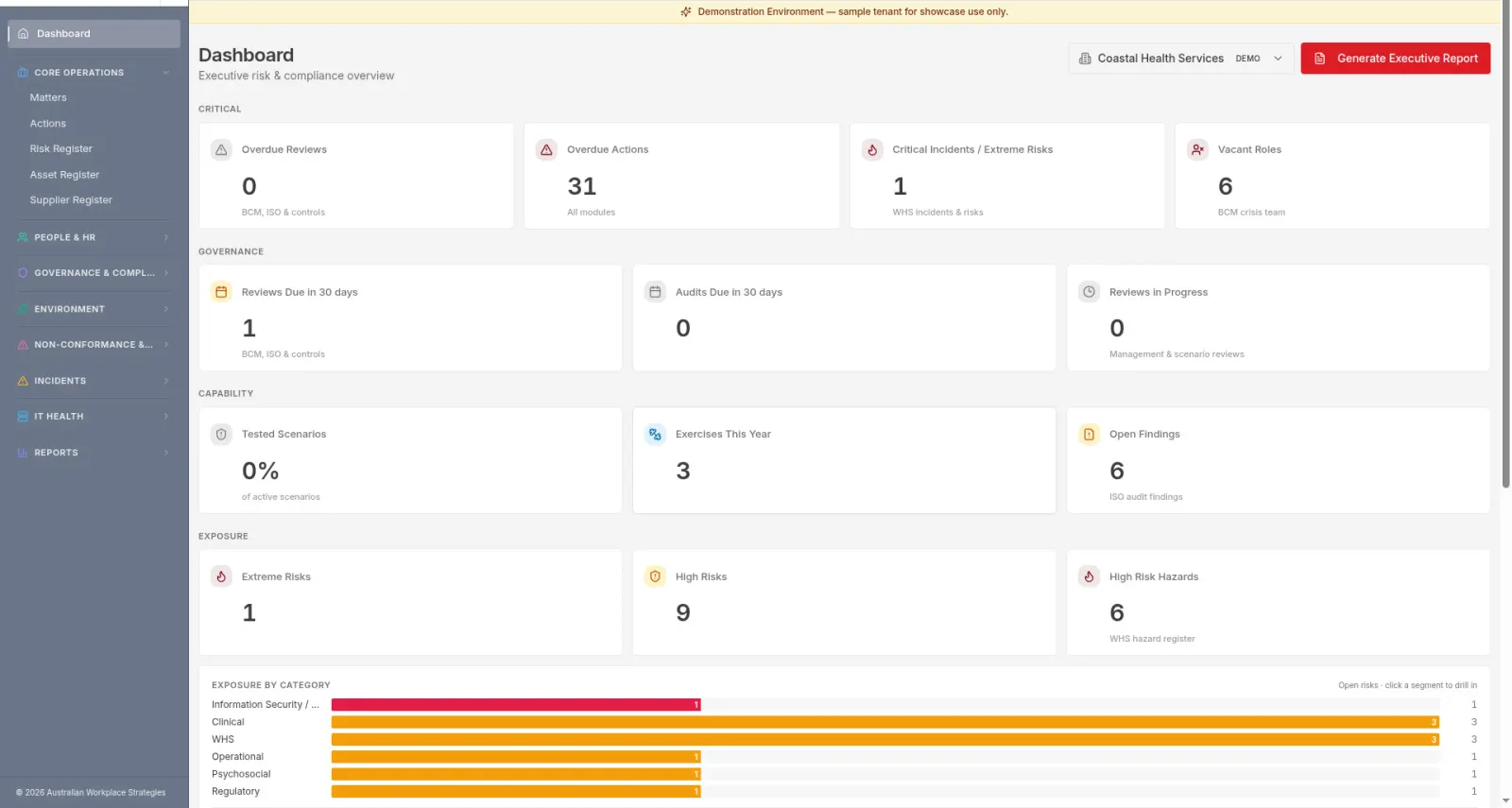
Governance, Risk & Compliance
How GRC technology supports workplace risk and assurance
Spreadsheets and inboxes do not scale for modern workplace risk and assurance. We outline what GRC technology should do for a workplace-risk-focused organisation.
Read briefing →
Governance, Risk & Compliance
Building a well-documented workplace compliance framework
A workplace compliance framework should be coherent across HR, safety and operations. We outline the building blocks employers should put in place.
Read briefing →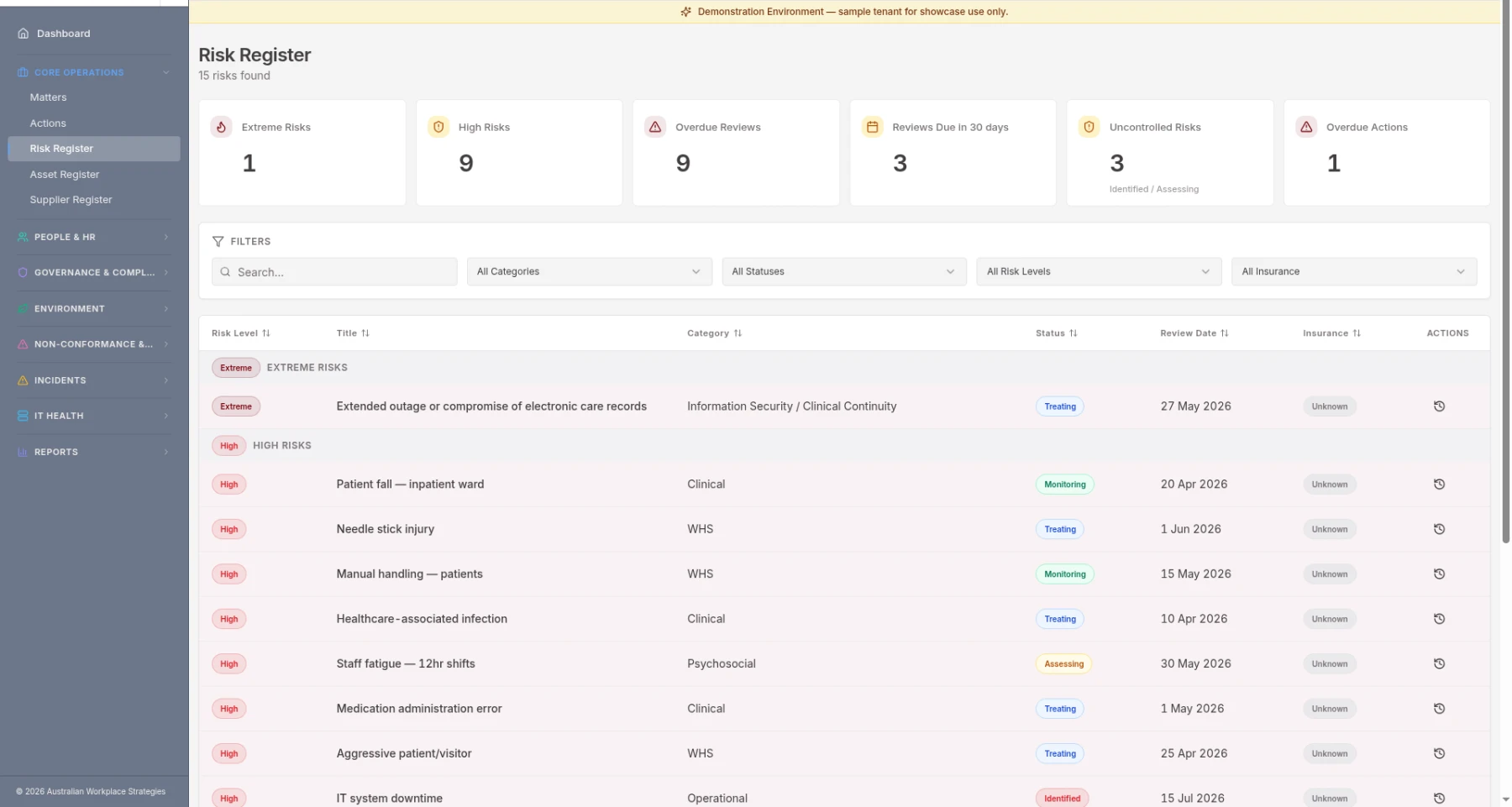
Discuss a workplace matter with AWS
Briefings can be scoped on a confidential basis. We respond within two business days.