Governance, Risk & Compliance
How GRC technology supports workplace risk and assurance
Spreadsheets and inboxes do not scale for modern workplace risk and assurance. We outline what GRC technology should do for a workplace-risk-focused organisation.
Key points
- Spreadsheets and inboxes do not scale for modern workplace risk and assurance.
- GRC technology should hold obligations, controls, evidence and assurance workflows in one place.
- Reporting should be built from the underlying data, not assembled manually each cycle.
- Workflow, alerts and review cycles support consistency and reduce reliance on individuals.
- Workplace risk is a natural fit for GRC technology when integrated with HR, safety and operations.
What GRC technology can and cannot do
Governance, risk and compliance technology supports a well-designed operating model — it does not substitute for one. Where the underlying framework is unclear, technology amplifies the confusion. Where the framework is clear, technology reduces the cost of operating it, improves the quality of evidence and makes reporting consistent.
Successful implementations start with the operating model and then choose technology to support it, not the other way around.
Visibility across obligations, controls and evidence
The most consistent benefit of GRC technology is visibility. Holding obligations, controls, evidence and assurance findings in a single structure allows the organisation to see what is in place, what is operating and where exceptions exist. That visibility supports management, executive and board reporting at a fraction of the cost of building it from spreadsheets each cycle.
Visibility is also a discipline. The act of moving the framework into a structured system surfaces gaps that were previously hidden inside informal practice.
Integration with operational systems
GRC platforms add the most value when they integrate with the operational systems that already hold relevant data — HR systems, learning management systems, payroll, case management. Integration reduces duplicate data entry and shortens the loop between operational activity and assurance reporting.
Integration should be designed pragmatically. Not every system needs to connect on day one, and over-engineering at the outset is a common implementation risk.
Workflow, evidence and assurance cycles
Workflow capabilities — task assignment, review and approval, escalation — turn assurance activity from an event into an operating rhythm. Evidence is collected as part of the workflow rather than being assembled retrospectively, and exceptions are routed to the right owner without manual coordination.
Assurance cycles run more consistently when the system tracks their planning, execution and findings rather than relying on individual diaries.
Reporting and board-level visibility
Reporting built from the underlying data is more accurate, more consistent and easier to refresh than reporting assembled manually each cycle. Executive and board reporting can move from after-the-fact summary to current operating picture, which changes the conversations those audiences can have.
Risk and obligations registers: a single structure for two views
A risk register asks what could go wrong and what is being done about it. An obligations register asks what is required and what is being done to meet it. The same control often answers both questions, and a single underlying structure — with two views over it — avoids the duplication and inconsistency that occur when the registers are maintained separately.
Holding both in the same GRC structure also produces useful cross-views: which obligations are most exposed by current risk; which risks would be reduced by strengthening a particular control; which controls are doing the most assurance work across the portfolio. These views are difficult to assemble when the underlying data lives in different places.
Action tracking and exception handling
Action tracking is where most spreadsheet-based frameworks fall down. Actions are agreed at the point of finding, recorded somewhere, and then drift. A GRC platform can hold actions against the finding that produced them, assign owners and deadlines, route reminders, and surface overdue items in the same dashboard as the underlying risk. The change is operational, not cosmetic — actions are far more likely to be completed when they are visible to the people accountable for the area they relate to.
Exception handling should be designed in from the start. Most controls will operate as expected most of the time; the value of GRC technology is concentrated in how cleanly it handles the cases where they do not.
Dashboards and reporting that change the conversation
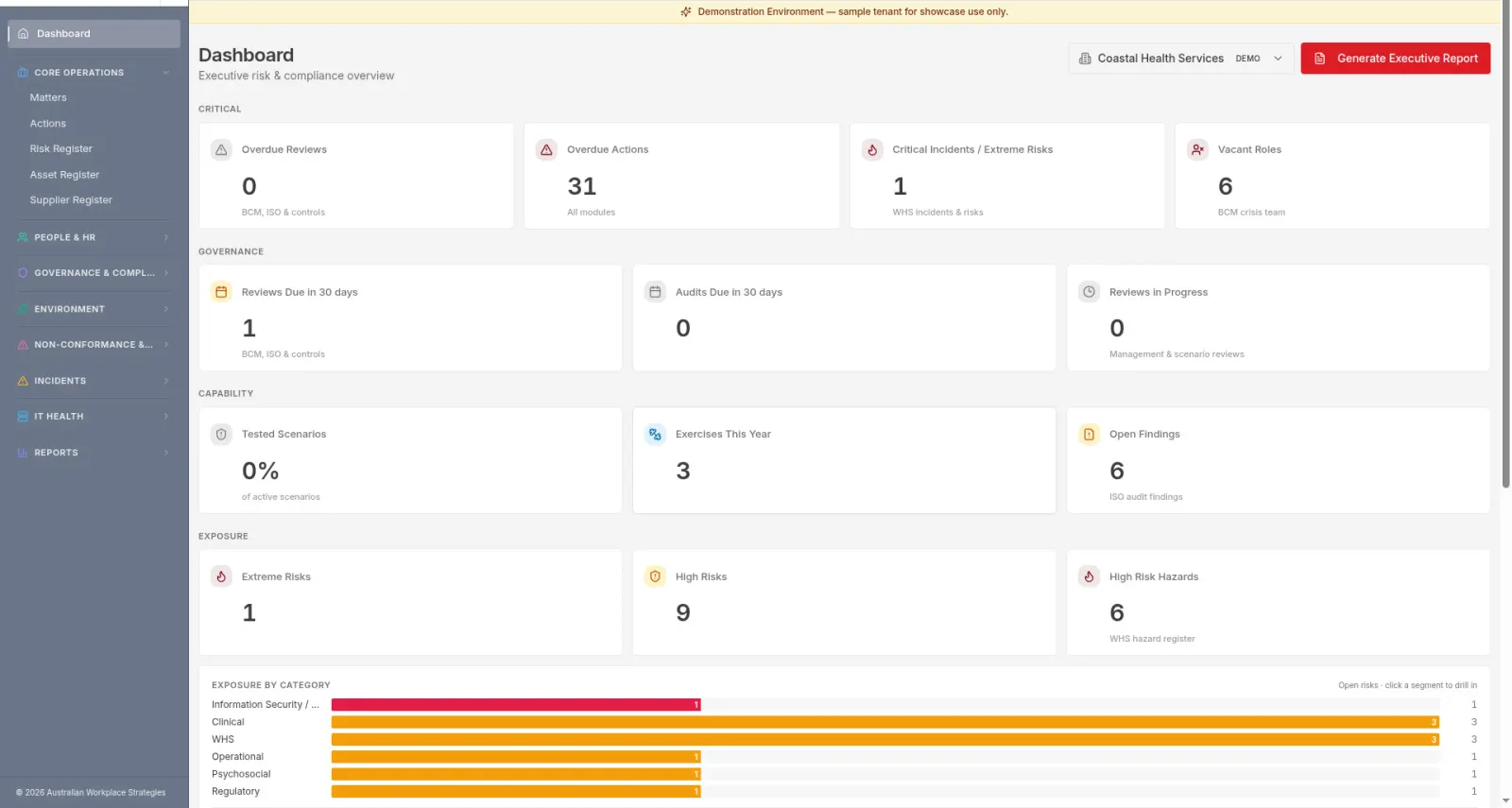
Dashboards built from the underlying data change the cadence of executive and board conversation. Audiences can see the current operating picture between formal reporting cycles, which shifts the conversation from after-the-fact summary to current operating posture. Reports become a snapshot of a live picture rather than a separately assembled artefact, which materially improves accuracy and reduces the lag between operational reality and management visibility.
Dashboards should be designed for the audiences that will use them. A board view, an executive view and an operational view typically draw on the same underlying data but emphasise different layers. Designing them as a related set, rather than as separate products, is what allows the same numbers to be read consistently across the organisation.
How AWS supports GRC technology adoption
AWS supports employers in defining their workplace risk operating model, selecting and configuring GRC technology to support it, and uplifting capability across the affected teams. The work is grounded in the organisation's existing systems and obligations rather than imposed as a parallel structure. Where Strobe is the chosen platform, AWS implements directly; where another platform is in place, AWS supports the operating model and content build around it.
What employers should consider
- Whether the underlying operating model is clear enough to be supported by technology.
- Whether the platform will hold obligations, controls, evidence and assurance in a single structure.
- Which operational systems will integrate at launch and which will integrate later.
- Whether workflow, evidence collection and assurance cycles are designed into the implementation.
- Whether reporting will be built from the underlying data rather than assembled separately.
- Whether capability uplift across affected teams is planned alongside the implementation.
Frequently asked questions
- What does GRC technology actually do for workplace risk?
- It holds obligations, controls, evidence and assurance in a single structure with workflow over the top, so the operating model is supported by technology rather than spreadsheets. The benefit is visibility, consistency and reporting drawn from the underlying data rather than reassembled each cycle.
- Do we need a defined operating model before adopting GRC technology?
- Yes. Where the underlying framework is unclear, technology amplifies the confusion. AWS typically defines or uplifts the operating model alongside the platform implementation.
- How does Strobe fit into this?
- Strobe is the AWS-supported GRC platform built around how workplace risk is actually managed. The Strobe page describes the platform; the GRC Technology service page describes the implementation work AWS does around it.
Discuss this matter with AWS
Briefings can be scoped on a confidential basis. We respond within two business days.
Contact AWSRelated briefings
Governance, Risk & Compliance
Building a well-documented workplace compliance framework
A workplace compliance framework should be coherent across HR, safety and operations. We outline the building blocks employers should put in place.
Read briefing →Governance, Risk & Compliance
Building a workplace compliance framework that can be monitored and evidenced
Designing a compliance framework is the easier half. This guide covers operating one: the monitoring chain, evidence architecture, testing, exceptions, verified remediation and governance reporting.
Read briefing →Governance, Risk & Compliance
Business continuity planning for workforce disruption
How Australian employers build the workforce side of business continuity: business-impact analysis and minimum service levels, dependency mapping, lawful response options, decision authority, communication and privacy, safety in degraded operation, testing and controlled recovery.
Read briefing →