
Strobe GRC
Using Strobe to manage obligations, evidence and assurance workflows
Strobe is Australian Workplace Strategies' governance, risk and compliance platform. This article outlines how organisations use Strobe across obligations, evidence and assurance.
Key points
- Strobe is Australian Workplace Strategies' governance, risk and compliance platform.
- Organisations use Strobe to hold obligations, controls, evidence and assurance workflows centrally.
- Workflows support consistent intake, triage and case management for workplace matters.
- Reporting draws from live data, supporting board, audit and regulator-facing reporting.
- Strobe is configured to the organisation's structure rather than forcing a generic model.
What Strobe is built to do
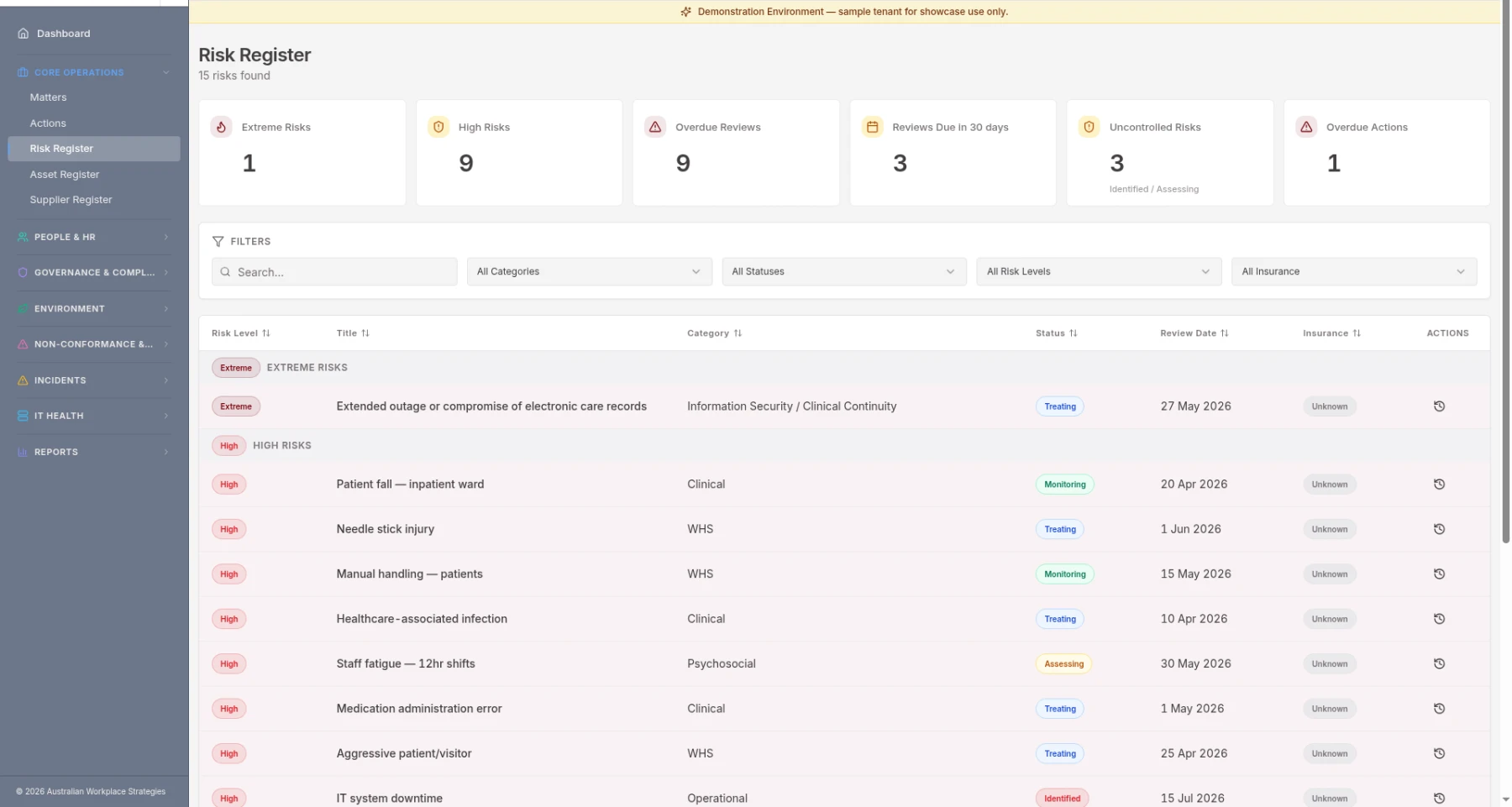
Strobe is the AWS governance, risk and compliance platform. It holds obligations, controls, evidence and assurance activity in a single auditable structure so the workplace risk operating model is supported by technology rather than spreadsheets and shared drives.
Strobe is designed around how workplace risk is actually managed — across employment, WHS, conduct and workforce governance — rather than as a generic compliance tool.
Obligations as a single source of truth
Strobe's obligations layer captures legislative, regulatory, contractual and policy requirements relevant to the workforce, with the source, the substance, the affected population and the responsible owner held against each. Updates flow through to the linked controls and evidence so the framework remains current.
Holding obligations in one place — rather than across multiple spreadsheets owned by different teams — reduces the risk of orphaned obligations and inconsistent interpretations.
Controls linked to obligations with named owners
Each obligation is linked to one or more controls in Strobe, with named owners and defined operating expectations. Control owners can see what they are responsible for, what evidence is expected, and when assurance activity is due.
Where controls operate at the limits of their effectiveness, that risk is visible in the platform rather than hidden in informal practice.
Evidence collected through operations
Strobe supports the collection of evidence as part of normal operations — training completion, sample checks, acknowledgements, system reports, attestations. Evidence is held against the control it supports, with the date, source and reviewer captured.
Exceptions are routed through workflow to the appropriate owner rather than collected at the end of an assurance cycle.
Assurance cadence and reporting
Strobe holds assurance activity — planning, execution, findings, actions, verification — in the same structure as the obligations and controls it tests. Boards, audit committees and executives see reporting built from the underlying data, with a consistent picture across cycles.
The same structure supports regulator engagement, internal audit and external assurance without requiring the framework to be reassembled for each audience.
Workflows: intake, triage, case management and review
Strobe holds workflow for the operational processes that surround workplace risk: complaint intake, triage decisions, case management for investigations and conduct matters, action tracking, review and verification. Each step is captured in the same structure, with the responsible owner and the date of action recorded, so the matter has a single coherent file rather than scattered email threads.
Workflow also enforces the discipline that defends the matter later. Triage that records its reasoning, case files that capture decisions as they are made, and reviews that close out with verification all produce records that hold up under subsequent scrutiny — internal, external or regulatory.
Assurance workflows: planning, execution, findings, action, verification
Assurance in Strobe is treated as a workflow rather than an event. A planned cycle defines what will be tested, when and by whom; the execution captures findings as they are produced; the action phase assigns owners and deadlines; and verification confirms that the action has produced the intended change. Each phase is visible to the next so the cycle progresses rather than stalls.
Where assurance findings cluster — repeatedly against the same obligation, control or owner — the pattern itself becomes evidence the organisation needs a structural response rather than another round of individual corrective actions.
Integration and reporting across audiences
Strobe is designed to integrate with the operational systems that already hold relevant data — HR systems, learning management, payroll, ticketing and identity. Integration shortens the loop between operational activity and assurance reporting and reduces duplicate data entry. Integration should be sequenced pragmatically; not every system needs to connect on day one.
Reporting is drawn from the underlying data, so board, audit committee, executive, regulator and operational audiences each see a view of the same picture rather than separately assembled reports. The consistency materially reduces the time spent reconciling different versions of the same numbers.
How AWS supports Strobe implementation
AWS supports employers across operating-model design, Strobe configuration, content build, integration with existing systems and capability uplift, delivered through the GRC technology service line. The work is scoped to the organisation's existing obligations and controls rather than imposing a new structure on top of them — the platform reflects the way the organisation actually operates, not a generic template.
Where the underlying framework needs design or refresh before implementation, the work described in building a well-documented workplace compliance framework typically runs first or in parallel.
What employers should consider
- Whether obligations are currently captured in one place with named owners and clear sources.
- Whether controls are linked to obligations and have defined operating expectations.
- Whether evidence is collected as part of operations rather than assembled retrospectively.
- Whether assurance cycles are planned, tracked and reported through the same structure.
- Whether executive and board reporting is built from the underlying data.
- Whether the implementation is sized to the organisation's existing operating model.
Frequently asked questions
- What does Strobe hold?
- Obligations, controls, evidence and assurance activity in a single auditable structure, with workflow for intake, triage, case management, action tracking, review and verification. Reporting is drawn from the same data so board, executive, audit and regulator-facing views are consistent.
- Is Strobe a generic compliance platform?
- No. Strobe is designed around how workplace risk is actually managed across employment, WHS, conduct and workforce governance. It is configured to the organisation's structure rather than forcing a generic model.
- Who implements Strobe?
- AWS implements Strobe directly across operating-model design, configuration, content build, integration with existing systems and capability uplift. The GRC Technology service page outlines the implementation approach.
Discuss this matter with AWS
Briefings can be scoped on a confidential basis. We respond within two business days.
Contact AWS